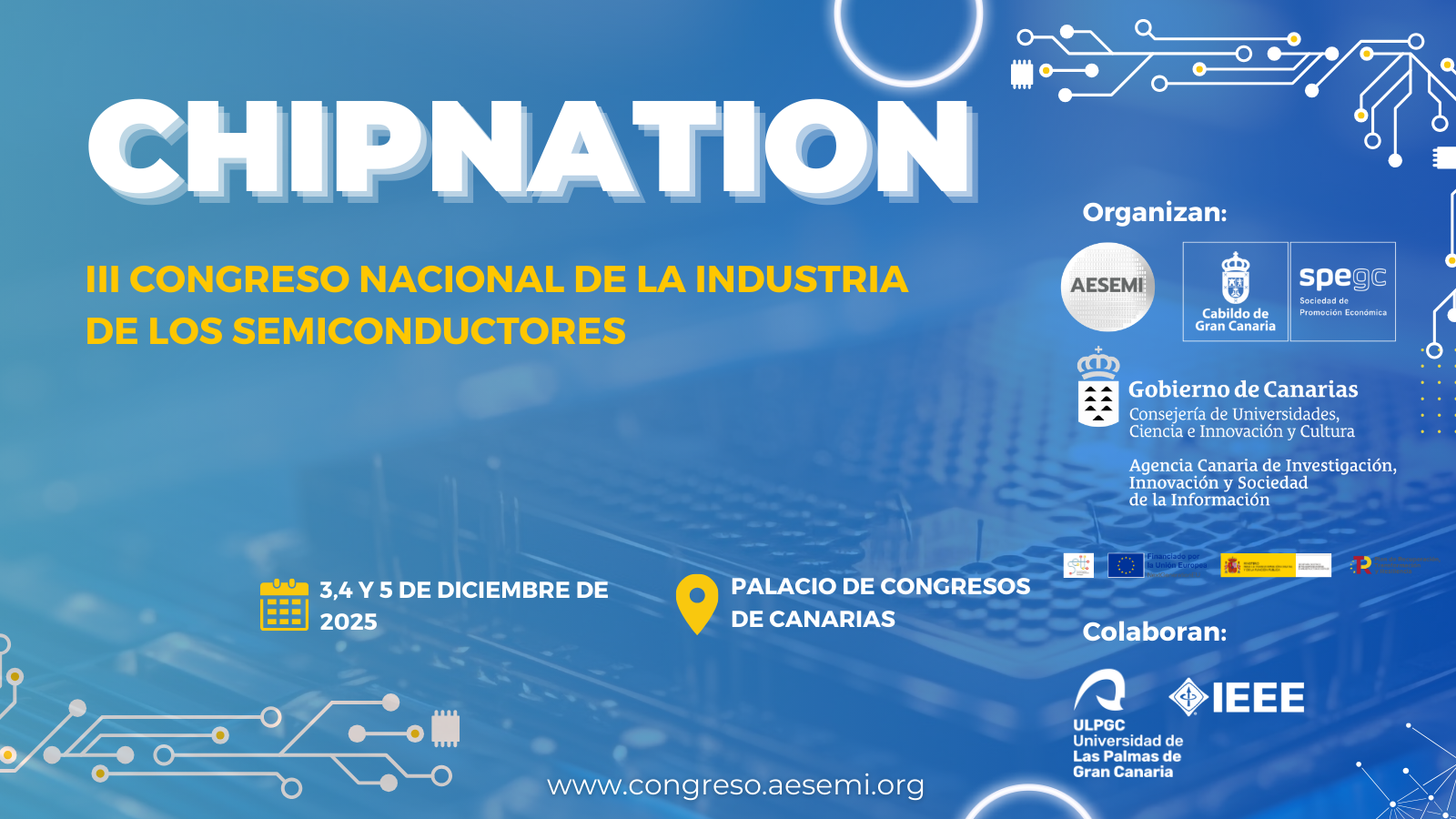
CHIPNATION, the National Semiconductor Industry Congress organized by the Spanish Semiconductor Industry Association (AESEMI), will hold its third edition on December 3, 4, and 5 at the Alfredo Kraus Auditorium Conference Center. Given the current state of the sector, this edition is expected to exceed all expectations. The event, which has established its position as the leading meeting point for the sector in Spain, already has more than 400 registered attendees and almost 100 speakers, bringing together leading technology companies, research centers, universities, public administrations, regional clusters, and European entities to discuss the evolution of the sector, investment opportunities, the development of specialized talent, and the technological challenges that will shape the next decade.
CHIPNATION will bring together institutional representatives commensurate with the importance of the sector, led by the Minister of Digital Transformation and Public Administration, Óscar López. Authorities from the Canary Islands Government will also be present, including its president, Fernando Clavijo, the president of the Cabildo, Antonio Morales, and other authorities.
The conference will feature the direct involvement of the Spanish Society for Technological Transformation (SETT), represented by its Director General, Javier Ponce, and strategic managers such as José María García, who will address the role of the administration as a driver of investment. At the international level, the conference will also feature top-level speakers such as the CEO of IMEC, Europe’s leading microelectronics R&D center, and the CEO of SEMI Europe, reinforcing the European positioning of the event. In addition, Geoffrey Lee, vice president of Siemens EDA for Europe and one of the most influential voices in electronic design globally, will deliver the event’s keynote address.
At the regional and territorial level, the Canary Islands Agency for Research, Innovation and the Information Society (ACIISI) and the Canary Islands Chip Cluster will participate, with Franco Hormiga and Braulio Quintana presenting the actions of the Canarychip strategy; Other territories will also be represented through the Catalan Semiconductor Alliance, the Valencia Silicon Cluster and Valencia Innovation Capital, which will present regional initiatives to strengthen industrial capabilities. The professional ecosystem will also be supported by key organisations such as the Official Association of Telecommunications Engineers (COIT) and the national scientific network involved in the Perte-Chip Chairs. At European level, the European Innovation Council (EIC), EIT Digital and SEMI Europe will participate, represented by Isabel Obieta, Nata Jaipashvili and Bernie Capraro.
High-level sponsors
The conference is backed by key sponsors in the sector, including Siemens, Deloitte, KD, Semidynamics, IMEC, INL, Rocket Software, Tenstorrent, the Valencian Semiconductor Cluster and Celestia TST, whose participation demonstrates the growing international interest in Spain’s strategic positioning in the chip industry. While in 2024 there were more than 400 registrants and over 300 in-person participants, the 2025 edition aims to set a new milestone in terms of participation and institutional representation.
In addition to academic and institutional content, CHIPNATION will offer a large exhibition area with more than 20 stands from companies, universities and technology centres, B2B spaces for private meetings between entities, and two social activities —a gala dinner and networking cocktail party— designed to facilitate connections that drive new projects and collaborations.
The sector at a decisive moment
AESEMI is organising this conference at a decisive moment for the sector, as we await the reform of European chip legislation and the next European budgets, which will determine, among other issues, the continuity of funds such as PERTE Chip. Added to this context is growing international competition and the need to accelerate industrial capacity and talent in Spain, factors that make it particularly important to bring together administrations, companies and technology centres to define common priorities.
Congress agenda
The conference content is structured over three days with institutional, technical and specialised blocks. On 3 December, CHIPNATION will open with a session focusing on the global vision of the industry, including an institutional opening and a debate on Spain’s role in the international semiconductor race. This first day will offer an analysis of the evolution of PERTE CHIP, the impact of the European CHIPS Act, the consolidation of national initiatives and the deployment of new pilot lines in Spain, as well as focusing on strengthening technological sovereignty and collaboration between administrations.
December 4 will be the most intense day of technical content, with simultaneous activities on three stages. The auditorium will host an analysis of the technological outlook for Spain, followed by the ‘Women in Semiconductors’ session and an international debate on technological cooperation in 2025. At the same time, Technical Room 1 will host presentations on electronic design challenges, the impact of artificial intelligence on integrated circuit design flows, and an extensive block dedicated to the RISC-V ecosystem with eight consecutive presentations, a SOHA carousel with researchers, and a round table with experts. Technical Room 2 will bring together content on integrated photonics; a neuromorphic block and four technical demonstrations of SNN, DVS, NAS and CNN processors; and an investment block led by AESEMI-Ikerlan. This conference provides a comprehensive overview of national R&D capabilities, the maturity of the business fabric and the scientific advances that are already being applied in industry.
5 December will be devoted to institutional coordination, specialised talent and the European perspective on semiconductor research. The morning will begin with the Spanish Institutions Block, addressing national alignment, regional strategies and the role of the administration as a driver of investment and catalyst for technological projects. At the same time, Technical Room 2 will present the Chip-Talent Chairs Block, a tour of new academic initiatives aimed at training the next generation of specialists in design, manufacturing, photonics, verification and other key areas of microelectronics. The day will culminate in the auditorium with the session ‘Research & Innovation in Europe: A perspective from the Canary Islands’. This space will allow for an analysis of European dynamics in financing, technological cooperation and strategic coordination between regions.
Anyone interested can consult the full programme and register via the official conference website.